

On Tuesday, Underdog and Crypto.com made waves by announcing a significant partnership. Jeremy was on TV and everything.
But, under the hood, Underdog has shipped a kind of Same Game Parlay (SGP) you haven’t seen before: one leg is a federally regulated moneyline listed on Crypto.com’s Designated Contract Market (DCM), the others are state‑regulated Fantasy player prop picks. It’s a single flow inside the Underdog app, and it’s now live in 16 states that don’t have established sportsbooks, including California and Texas
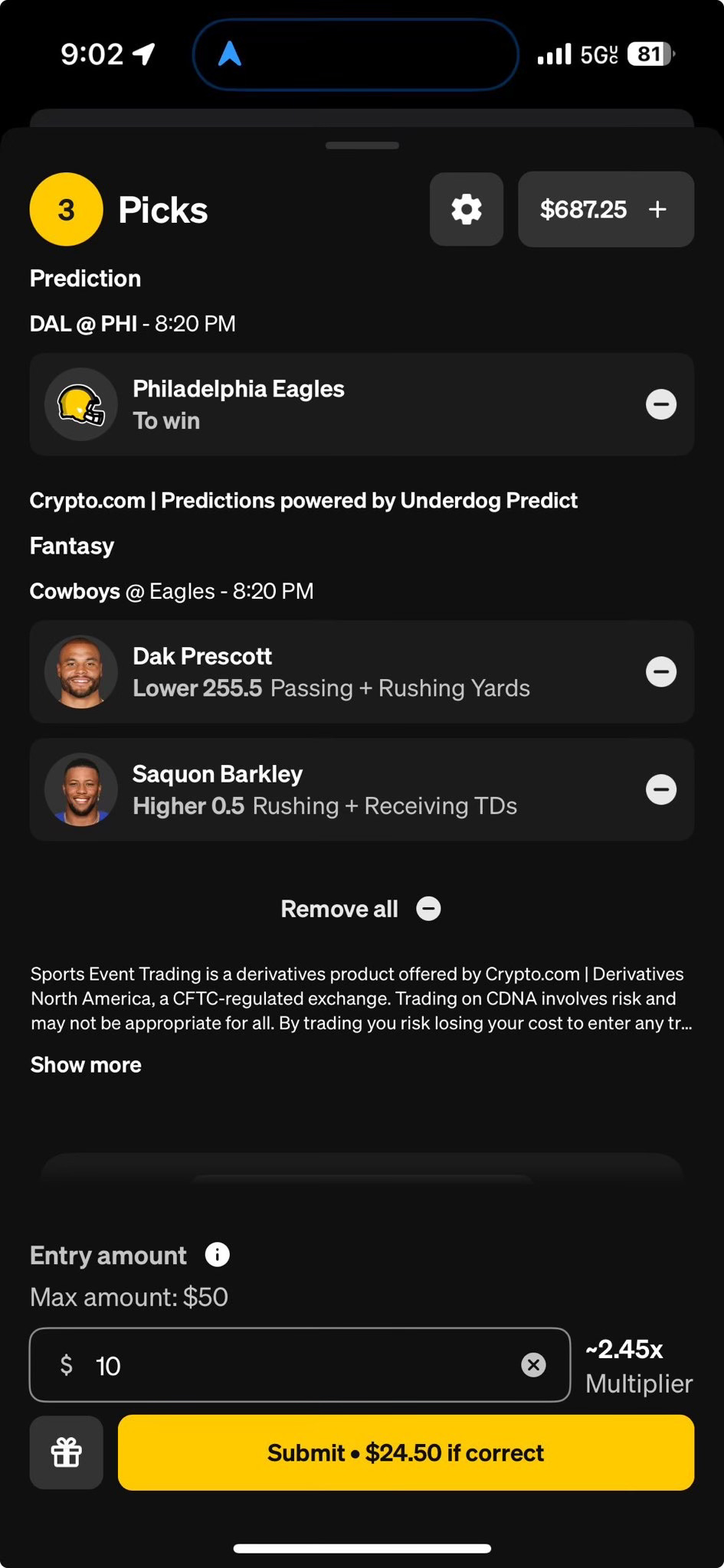
What looks like a UX flourish is really a market-structure breakthrough.
Underdog isn’t a derivatives exchange or a broker. It’s piggybacking on Crypto.com’s DCM1, Crypto Derivatives North America (aka CDNA, fka Nadex), via a seldom‑used access model that sits somewhere between a pure front‑end and a CFTC-registered Introducing Broker (IB). It’s also a “Fantasy” sports operator, regulated by state authorities, so the unlock is in combining the two.
If that sounds like a regulatory hair to split, it is… and it’s the most interesting thing about this launch.
What the heck?

I, too, was confused when I saw the announcement! I got a lot of inbound about it and could only shrug my shoulders. But now, I’m here to help out.
Underdog now surfaces CDNA sports contracts to eligible users inside its app, alongside its traditional fantasy contests. In select states, users can “combine” a DCM moneyline leg with fantasy legs in a single UX.
Underdog is leveraging a role as a technology service provider (TSP), not an Futures Commission Merchant (like Robinhood, which carries customer funds) or an IB (which solicits and routes futures orders). That distinction matters because both FCMs and IBs need to register with the National Futures Association and the CFTC. They regulate supervision, disclosures, and who holds the bag on customer funds.
It’s important to note here that Crypto.com itself is a TSP to CDNA. It’s a unique structure that has gone under-discussed because, facially, of course Crypto.com would have the front-end UX to the exchange and clearinghouse they own themselves. That’s what Kalshi.com is, after all2.
No FCM in the loop
Orders for the DCM leg connect directly to Crypto.com’s DCM through Underdog’s TSP integration. That’s atypical in retail futures, where an FCM usually carries customer funds and routes orders, and it highlights how unusual this access model is in a consumer-facing app.
The users funds are moved to the Crypto.com / CDNA clearinghouse seamlessly as the user makes a CDNA trade3. Underdog, for their part, has made this function invisible to the end-user. I’ve never seen anything like this, and it’s slick. The CME / FanDuel partnership is purported to be an entirely separate app, which is, frankly, going to be a terrible user experience4.
TSP access isn’t new: Crypto.com uses it for CDNA/NADEX, Coinbase used it for FairX, and Trading Technologies5 uses it to routes orders without being an FCM or IB. Former CFTC General Counsel Rob Schwartz has even framed Underdog’s role as a “tech provider.” The catch is strategic: as a TSP, Underdog effectively hands customers to Crypto.com and must co‑brand—promoting a competitor. With an FCM setup, Underdog wouldn’t face those constraints.
One tap, two regimes
The app lets users assemble a “parlay” that mixes one DCM moneyline (e.g., Dallas to win) with multiple fantasy over/under legs. Legally, these are distinct transactions governed by different rules; in‑app, they feel like one ticket.
Here’s the payout choreography:
If DCM leg hits, proceeds from the DCM leg are applied to fund the fantasy payout, creating the appearance of a seamless, single settlement. Underdog foots the losses not covered by the DCM win in the same way they take the risk of a typical fantasy bet.
If the DCM leg misses, the fantasy legs actually settle independently under the state-level regulated fantasy system.6
A very strategic partnership
Both Crypto.com and Underdog gain a lot from this set-up.
Until now, Crypto.com sports markets has been struggling to keep up with it’s primary competitor in Kalshi - their typical daily sports volume traded (before this deal) hovers around $1 million, while Kalshi often trades upwards of $40 million7. Kalshi’s edge here is their integrations with FCM brokers such as Robinhood and WeBull - they are delivering the customers and order flow. Now, Crypto.com gets to tap into Underdog’s sizable user base as a leading Fantasy sports betting app and can finally get some momentum going.
Underdog comes out nicely as well. The Fantasy structure that they typically operate under necessitates that the constituent legs may only be about individual player performance (aka “props”). By splicing in the game winner (aka “moneyline”) trade from CDNA, they get to offer their users a complete SGP product on very nearly8 par with what DraftKings and Fanduel offer in the states that they have worked so hard to become legal in.
Bettors love telling a story with their SGP bets: “the Eagles will win tonight because Barkley will over perform and Prescott will underperform.”9 For the first time ever, this product is available to the millions of people residing in California, Texas, and the 14 other states that Underdog is rolling this out to10.
What now?
Underdog’s TSP-driven splice of a CDNA moneyline into a fantasy parlay is a new playbook. I expect fast followers: any operator with a fantasy footprint can replicate this if they make a deal with a DCM and wire the pipes.
Three pressure points will determine how far this scales.
First, disclosures and marketing precision: a “single-bet” UX masking two legal legs demands crystal‑clear language about counterparties, custody, and settlement. “Parlay” phrasing, multipliers, and win‑probability displays will draw scrutiny.
Second, classification: Underdog is operating as a TSP, not an IB. If regulators decide it walks like introducing brokerage, NFA/CFTC obligations around supervision and record-keeping could snap into place. That said, Underdog has years of experience working legally within state-level regulatory frameworks.
Third, state reactions: aiming this at CA/TX and other non‑sports‑ states is savvy, but AGs and gaming regulators may probe whether the combined presentation blurs statutory lines.
Net‑net, consumers get a sportsbook‑like experience where traditional sportsbooks aren’t legal, and CDNA gets real distribution. If the TSP posture holds and ops are tight—clean KYC/AML bifurcation, no timing/credit seams, and rigorous disclosures—this model could quietly redefine access to event contracts and sports‑adjacent markets.
You can learn more about the alphabet soup (DCM exchanges, IB, FCM brokers, etc) surrounding all of this in my regulatory primer! I get that it’s kind of a lot to take in if you’re new to the prediction market space, but it is necessary to understand what’s going on here.
But Kalshi is not a TSP. I know, it’s confusing...
Technically, the funds are withdrawn from the Underdog account and deposited into a CDNA account, according to an Underdog spokesperson.
As of time of writing. I think this move could shake up a lot of industry players’ strategies! We’ll see.
This firm’s name may be a contender for worst SEO of all time.
To get into the math of how this works (I am de-vigging all the numbers for simplicity’s sake):
Imagine you want to risk $10 on a three leg parlay, where each leg has a fair value of 50%: Team A wins (CDNA), Player A over (Underdog), Player B under (Underdog).
The fair value of this “parlay” would be .5 * .5 * .5 = 0.125, or an 8x multiplier
What Underdog does here is take $9 of your $10 and put that in the CDNA leg, and put the remaining $1 in the Fantasy leg.
If the CDNA leg wins, you’ll get $18 back. Underdog will then take that $18 and put it into the fantasy portion, which is .5 * .5 = 0.25, or a 4x multiplier.
If the Underdog leg hits, your $18 becomes $72, the $1 becomes $4, and you get back $76
If the CDNA leg misses, your $9 goes to $0. If the Underdog leg hits there too, you’ll get back $4.
Due to the dual-trade structure, your upside is slightly limited and your downside is slightly improved.
According to a 50CD analysis of trade data.
The slight drawback is that entries must include multiple players from multiple teams—no single‑player picks and no all‑Eagles (you need a Cowboys or another team, too).
Can’t believe I have to say this, but this is not financial advice.
50CD understands that this list is essentially all the states where Fantasy is legal but traditional sports betting is not.